
A peptide clinic business rarely fails because of the science. In most cases, it fails because the clinic added a product before it designed a business. The protocol may be sound, and the doctor may be excellent. Yet the margin stays thin and patients drift away. Increasingly, the regulator also starts asking questions the clinic cannot answer.
Earlier, I wrote about peptide therapy clinic management and the operational gaps that sink programmes once they are running. This article looks one step earlier. It asks what the business needs before the first patient books.
Where a Peptide Clinic Business Really Loses Money
Most clinics add peptides the same way they add a new facial or IV drip. They put it on the menu, set a price per vial or per session, and wait for demand. However, peptides do not behave like a single treatment. A patient needs an assessment, a prescription, monitoring and a review. In other words, the clinic delivers a programme but charges for a product.
As a result, three leaks appear. First, the price covers the product but not the clinical time around it. Second, nobody tracks how many patients complete the full course. Third, follow-up appointments happen free of charge because nobody built them into the offer. Each leak looks small on its own. Together, however, they turn a promising service line into one that quietly costs the clinic money.
By contrast, I have seen one clinic include every consultation in the price of the therapy. The patient pays for the peptide programme and receives a monthly consultation and follow-up throughout the process. The clinic does this because it knows that follow-up is key to the result.
What Does a Peptide Clinic Business Need Before Launch?
A peptide clinic business needs four foundations before launch. First, a defined patient group. Second, a priced programme rather than a priced product. Third, a compliance file that matches local regulation. Finally, one named person who owns each patient from assessment to review. Without these, the clinic sells treatments it cannot track, defend or repeat profitably.
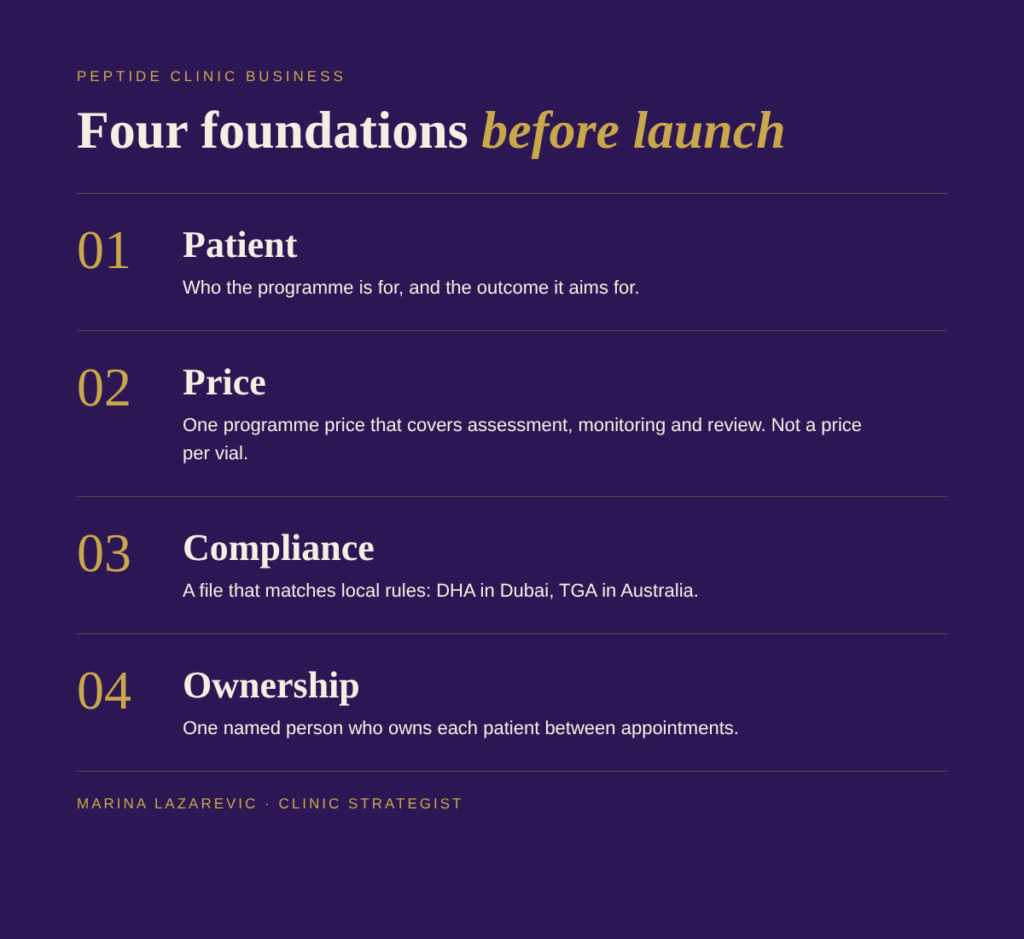
Each foundation answers a different question. The patient group answers who the programme is for. The pricing answers whether it pays. Meanwhile, the compliance file answers whether it is allowed, and ownership answers whether it lasts. In practice, a clinic that cannot answer all four is not ready to launch, even if the protocol is ready.
Running a Peptide Clinic in Dubai or Australia: Compliance First
In both markets, regulators now pay close attention to peptides. In Dubai, the Dubai Health Authority issued a circular on 29 July 2026 titled "Regulations for Handling Peptide Products in Healthcare Facilities". It asks all licensed professionals and facilities to comply with the attached rules. Similarly, in Australia, the TGA has published guidance on importing, compounding and supplying unapproved peptide products. It warns that promoting unapproved peptides is "likely to breach" advertising laws.
Therefore, compliance is not a task for the end of the project. Instead, it shapes the offer itself: which products the clinic uses, how it sources them, what it says in marketing and who prescribes. A clinic that designs the programme first and checks the rules later often redesigns it twice. That is why the safer order is the reverse. Read the rules first, then build the programme inside them.
This is my reading as a business strategist, not legal or medical advice. Every clinic should confirm the detail with its licensing authority and its own medical director.
If you want more notes like this one, plus two free guides for clinic owners, join Dubai Clinic Notes here.
From Treatment Menu to Programme: Pricing the Outcome
A treatment menu sells items. A programme, by contrast, sells a result over time. That difference changes almost everything about pricing. For example, a programme price can include the initial assessment, the prescription, the check-ins and the final review. Consequently, the patient sees one clear commitment instead of a list of separate costs.
This structure also protects the clinic. When the follow-up is part of the price, the team has a reason to schedule it. When it is free, however, it is the first thing that slips in a busy week. Moreover, a defined programme gives the clinic a natural moment to discuss the next step, instead of hoping the patient returns alone.
The same logic sits behind a sound longevity clinic business model. In both cases, the clinic earns from continuity, not from single visits.
How to Fix a Peptide Clinic Business Before You Scale
Fixing the model rarely requires a new product. Instead, it requires a few decisions, made in the right order:
- Define the patient. Name the group the programme serves and the outcome it aims for, within what regulation allows.
- Price the programme. Build one price that covers assessment, monitoring and review.
- Assign ownership. Give one coordinator responsibility for every patient between appointments.
- Measure completion. Track how many patients finish the course, not only how many start.
- Review compliance every quarter. Peptide rules are moving in both markets, so the file needs regular attention.
Once these steps are in place, growth becomes a decision rather than a gamble. Without them, more patients simply mean more leakage. This is also where a clinic consultant in Dubai adds the most value: in the order of decisions, not in the protocol.

Systems that stay after I leave.
If you are planning or rebuilding a peptide programme, join Dubai Clinic Notes. You will receive weekly notes on clinic systems and two free guides for clinic owners. Join Dubai Clinic Notes.
